Hindu
 Diwali 2026 दीपावली
The Festival of Lights
Sunday, 8 November 2026
In 2027: Friday, 29 October 2027
Moon calendar: 8 Nov 2026
Amavasya (15), Krishna Paksha (new moon)
Month: Kartik (purnimanta, North India), Ashwin (amanta)
Vikram Samvat 2083 · Shaka Samvat 1948
Hindu months are named two ways. North India (purnimanta) ends the month on full moon and calls this night Kartik Amavasya; Gujarat, Maharashtra and the South (amanta) end it on new moon and call it Ashwin Amavasya.
Diwali, the festival of lights, celebrates the victory of light over darkness with Lakshmi Puja, rows of diyas, sweets and family gatherings on the new moon night of Kartik.
How the date is fixed: Amavasya (new moon) of the Hindu month of Kartik in the purnimanta calendar (Ashwin in the amanta calendar)

Lakshmi Puja (Pradosh Kaal) muhurat
| Year | Date | Muhurat | Duration |
|---|---|---|---|
| 2026 | Sun, 8 Nov | 5:48 pm to 7:14 pm | 1 hr 26 min |
| 2027 | Fri, 29 Oct | 5:55 pm to 7:21 pm | 1 hr 26 min |
Timings are for New Delhi and change by a few minutes from city to city. Check a local panchang for Dehradun or your own city.
Diwali day by day 2026
| Day | 2026 | What happens |
|---|---|---|
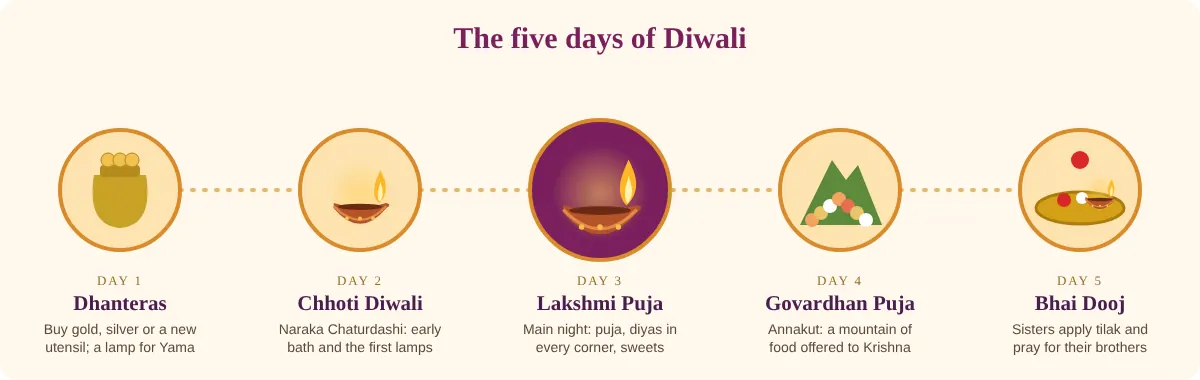
| Dhanteras | Fri, 6 Nov | Buying gold, silver or new utensils; a lamp for Yama at the door in the evening. |
| Naraka Chaturdashi (Chhoti Diwali) | Sun, 8 Nov | Early oil bath and a few lamps; Krishna's victory over Narakasura. |
| Diwali (Lakshmi Puja) | Sun, 8 Nov | Lakshmi and Ganesha puja after sunset, diyas across the house. |
| Govardhan Puja (Annakut) | Tue, 10 Nov | Annakut offering to Krishna; Balipratipada and Gujarati new year. |
| Bhai Dooj | Wed, 11 Nov | Sisters apply tilak and pray for their brothers. |
Dates follow the panchang for New Delhi. Some government lists for 2026 keep Naraka Chaturdashi on 7 November and Govardhan Puja on 9 November.
Why Diwali is celebrated
Diwali, also written Deepavali, is the most widely celebrated festival in India. The word comes from the Sanskrit deepavali, a row of lamps. It falls on Amavasya, the darkest night of the lunar month, and that is the point of it: families light diyas on the one night with no moonlight at all, to show that light can beat darkness, truth can beat falsehood and knowledge can beat ignorance.
For Hindu households the centre of the festival is Lakshmi Puja. Lakshmi is the goddess of wealth, prosperity and well-being, and she is worshipped together with Lord Ganesha, who is invoked first in every puja to remove obstacles. People believe Lakshmi visits homes that are clean, bright and welcoming, so the weeks before Diwali go into cleaning, repairing and decorating the house.
Diwali also marks a fresh start for business. Many traders close the old account books and open new ones, the bahi khata, after a puja at the shop. In Gujarat and among many Marwari families, the day after Diwali begins the new business year.
Above all, Diwali is a family festival. People travel long distances to be home, visit relatives, exchange sweets and gifts, give to the needy and make peace with those they have quarrelled with.
History and story of Diwali
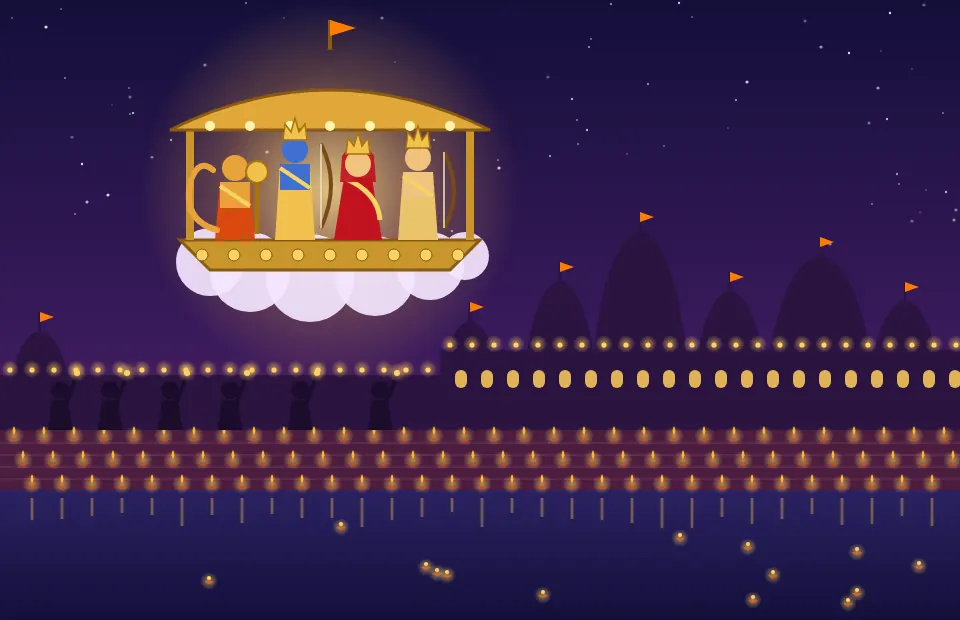
Several traditions explain why lamps are lit on this night. The best known comes from the Ramayana: Lord Rama returned to Ayodhya with Sita and Lakshmana after fourteen years in exile and the defeat of Ravana, and the people of the city lined the streets with lamps to welcome him home. Another belief holds that Goddess Lakshmi emerged from the churning of the ocean, the samudra manthan, on this Amavasya and chose Lord Vishnu as her consort. In much of South India the festival is tied to Lord Krishna and Satyabhama defeating the demon Narakasura, which is why the main celebration there falls on the morning of Naraka Chaturdashi.
Other faiths mark the same days for their own reasons. Jains observe the nirvana of Lord Mahavira, the 24th Tirthankara, at Pawapuri in Bihar, and many Jain families start their new year from here. Sikhs celebrate Bandi Chhor Divas, recalling the release of Guru Hargobind from Gwalior fort, and the Golden Temple in Amritsar is lit up for the occasion. In Bengal, Odisha and Assam the same night is given to Kali Puja.
The festival is centuries old. A seventh century Sanskrit play by King Harsha mentions a festival of lamps in this season, and the eleventh century scholar Al-Biruni described Diwali in his account of India. Swami Dayanand Saraswati, founder of the Arya Samaj, passed away on Diwali in 1883, and the Arya Samaj remembers him on this day.
How Diwali is celebrated
Preparations begin weeks earlier. Houses are cleaned from top to bottom, walls are whitewashed or painted and broken things are thrown out. Markets fill with people buying clothes, utensils, sweets, lights and gifts.
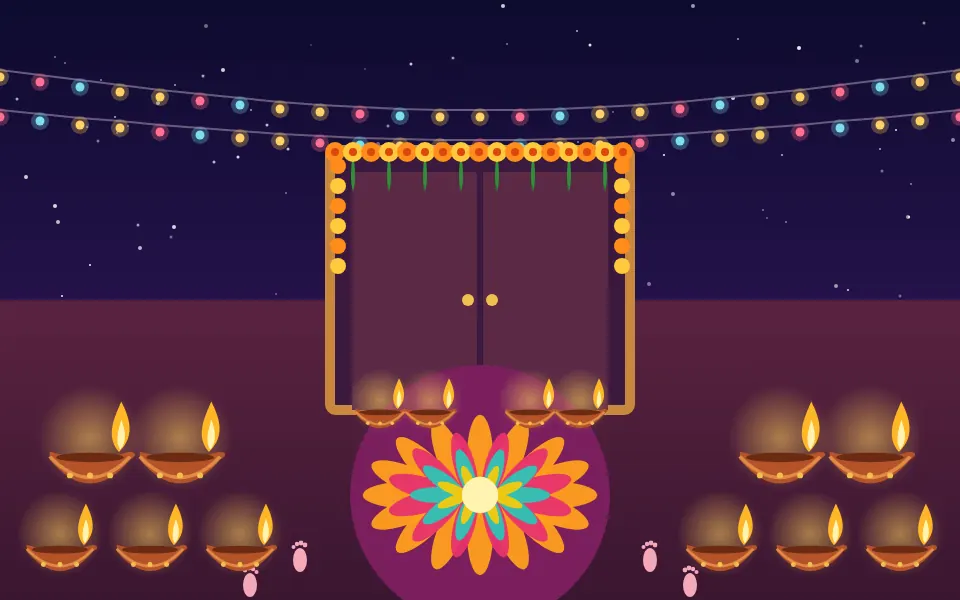
On the main evening, the entrance is decorated with rangoli, the door with a toran of marigold and mango leaves, and the balcony with strings of lights. After sunset, in the period called Pradosh Kaal, the family gathers for Lakshmi Puja. A wooden chowki is covered with red cloth and idols or pictures of Lakshmi and Ganesha are placed on it, often with Kuber, the treasurer of the gods. A kalash of water topped with mango leaves and a coconut, silver coins, jewellery, account books and a plate of sweets are set before the deities. The puja moves through lighting the lamp, the sankalp, invocation, offerings of flowers, roli, rice, kheel and batashe, and ends with the aarti sung together.
After the puja, diyas go on every door, window, staircase and corner, including the gate and the kitchen, so that no part of the house stays dark. Many families keep one ghee lamp burning through the night. Elders bless the younger members and sweets are shared with neighbours.
Fireworks have long been part of the night, but courts and many state governments now restrict crackers because of air pollution, often allowing only green crackers for a fixed time and banning them completely in some cities. Many families now choose a Diwali of lamps alone.
Symbols, food and customs of Diwali
The diya is the main symbol of Diwali: a small clay lamp with mustard oil or ghee and a cotton wick. Each lamp stands for the inner light that keeps away ignorance and fear. Rangoli, patterns of coloured powder, rice flour or flower petals at the doorstep, welcomes guests and the goddess. In Kumaon the same role is played by aipan.
Small footprints of Lakshmi drawn walking into the house, a swastik and the words shubh labh written in vermilion near the door, and a pot of coins all invite prosperity. Kheel (puffed rice) and batashe (sugar drops) are the classic offerings, along with sugarcane and seasonal fruit such as singhara (water chestnut).
Food is half the festival. Homes make or buy kaju katli, besan and motichoor laddoos, barfi, gujiya and soan papdi, along with salty snacks like mathri, namak pare and chakli. In the South, murukku and adhirasam are common. Boxes of sweets and dry fruits are the standard gift between families, friends and colleagues.
New clothes are worn on the main day. On Dhanteras many people buy gold, silver, a new utensil or a broom, believing it brings good luck for the year ahead.
Diwali across India
In Ayodhya, lakhs of diyas are lit along the Saryu river in the Deepotsav. Varanasi lights its ghats for Dev Deepawali on Kartik Purnima, about two weeks later. In Tamil Nadu and Karnataka, Deepavali morning begins with an oil bath before dawn and new clothes. In Maharashtra the day after Lakshmi Puja is Padwa, devoted to husband and wife, and children build small forts of mud.
In Kumaon, Uttarakhand, women draw aipan, the traditional red and white floor art, and paint small footprints of Lakshmi from the main door to the puja room, showing the goddess the way in. Lakshmi is also made from sugarcane stalks in some homes. In Garhwal, many villages also celebrate Igas Bagwal eleven days later on Ekadashi, while the Jaunsar Bawar area near Dehradun keeps its own Budhi Diwali about a month after the main festival. Folk belief says the news of Rama's return reached the hills late, while another story links it to the return of the Garhwali general Madho Singh Bhandari from a campaign in Tibet. On Igas night, people swing burning torches of pine wood, called bhailo, and dance in village courtyards. In Dehradun, markets such as Paltan Bazaar and Rajpur Road fill with shoppers in the days before Diwali.
Offices, banks, markets and travel during Diwali
Diwali is a gazetted holiday across India, and banks, offices and schools close; in 2026 it falls on a Sunday. Many states also give holidays for Govardhan Puja or Bhai Dooj, and Uttarakhand has in recent years declared a holiday for Igas Bagwal.
Diwali is a public holiday across India. The central government keeps it among the 14 compulsory holidays for its offices, and every state closes its offices too. In 2026 the main day falls on Sunday, 8 November, so most offices lose the weekday break, but several states and banks close on the days around it. In Uttarakhand, state government offices and banks in Dehradun are closed on Tuesday, 10 November for Govardhan Puja. In Uttar Pradesh, state offices also close on 9 and 11 November, and banks in Lucknow and Kanpur on Monday, 9 November and Wednesday, 11 November. The bank, central government and state government holiday pages for each state list every closure.
Stock exchanges keep Diwali as a trading holiday but hold a short special session in the evening called Muhurat Trading, whose timing the exchanges announce a few weeks earlier. Trading is closed again on Balipratipada, Tuesday, 10 November 2026.
Trains and buses run as usual, but long distance trains fill up weeks ahead and roads out of big cities are crowded in the days before. Markets stay open late, are busiest on Dhanteras and close early on Diwali evening. Hospitals and emergency services work normally.
Other names and related festivals
- Deepavali
- Deepawali
- Deepawali
- Festival of Lights
- Lakshmi Puja
- Deepavali in Tamil Nadu
 Ram Navami 26 Mar 2026
 Igas Bagwal (Budhi Diwali)
 Dhanteras 6 Nov 2026
 Naraka Chaturdashi (Choti Diwali) 8 Nov 2026
 Lakshmi Puja 8 Nov 2026
 Govardhan Puja 9 Nov 2026
 Bhai Dooj 11 Nov 2026
Frequently asked questions
When is Diwali in 2026?
Diwali falls on Sunday, 8 November 2026.
Is Diwali a bank holiday?
Banks close for Diwali in Karnataka in 2026, following the RBI holiday list of each region. Elsewhere it falls on a Sunday, when banks are closed anyway. Pick your state below to check.
Which state governments close for Diwali?
State government offices close for Diwali in Uttarakhand, Uttar Pradesh, Delhi, Bihar, Assam, West Bengal, Karnataka, Tamil Nadu, Kerala, Rajasthan, Telangana, Andhra Pradesh, Punjab, Himachal Pradesh, Chhattisgarh, Goa and Jammu and Kashmir in 2026. Pick your state below for its full holiday list.
Where is Diwali a restricted holiday?
Diwali is a restricted (optional) holiday for state government employees in Gujarat in 2026: employees may take it off, but offices stay open.
Is Diwali a central government holiday?
Yes. Diwali is one of the compulsory holidays for all central government offices in 2026.
Is the stock market closed on Diwali?
Diwali falls on a Sunday, when the markets are closed anyway.
What are the other names of Diwali?
Diwali is also known as Deepavali, Deepawali, Festival of Lights, Lakshmi Puja.
Why is Diwali celebrated?
Hindus celebrate Diwali to welcome Goddess Lakshmi and to remember Lord Rama's return to Ayodhya after defeating Ravana. Jains and Sikhs also mark the day for their own historical reasons.
What is Igas Bagwal?
It is a late Diwali celebrated in Garhwal, Uttarakhand, eleven days after the main festival on Ekadashi. People light bhailo torches of pine wood and dance in village courtyards.
Which gods are worshipped on Diwali?
Goddess Lakshmi and Lord Ganesha are worshipped together on Diwali night. In Bengal, Odisha and Assam, Goddess Kali is worshipped on the same night.
How can Diwali be celebrated with less pollution?
Use clay diyas, skip or limit crackers, choose green crackers where allowed, and gift sweets or plants instead of plastic items.
What is the Lakshmi Puja muhurat on Diwali 2026?
In New Delhi the Pradosh Kaal muhurat for Lakshmi Puja on Sunday, 8 November 2026 runs from 5:48 pm to 7:14 pm, about 1 hour 26 minutes. Timings differ slightly in other cities.
Next Hindu festivals (30 days)
-
17 OctSat
 Durga Puja
-
18 OctSun
 Durga Puja (Maha Saptami)
-
19 OctMon
 Durga Ashtami (Maha Ashtami)
-
20 OctTue
 Dussehra
-
20 OctTue
 Maha Navami
-
25 OctSun
 Sharad Purnima
-
26 OctMon
 Maharishi Valmiki Jayanti
-
29 OctThu
 Karva Chauth
-
6 NovFri
Dhanteras
-
8 NovSun
Naraka Chaturdashi (Choti Diwali)
-
8 NovSun
Lakshmi Puja
-
9 NovMon
Govardhan Puja
-
11 NovWed
Bhai Dooj
Major Hindu festivals
- 20 OctTueDussehra
- 4 MarWed
 Holi
Holi - 11 OctSun
 Sharad Navratri
Upcoming central government holidays
Holidays in your state
Bank, state government and school holidays differ from state to state. Pick your state:
Holidays and festivals calendar: October and November 2026
Central government holidays for all of India and major festivals. For bank, state government and school holidays, open your state: Andhra Pradesh, Assam, Bihar, Chhattisgarh, Delhi, Goa, Gujarat, Haryana, Himachal Pradesh, Jammu and Kashmir, Jharkhand, Karnataka, Kerala, Madhya Pradesh, Maharashtra, Odisha, Punjab, Rajasthan, Tamil Nadu, Telangana, Uttar Pradesh, Uttarakhand, West Bengal.
| Mon | Tue | Wed | Thu | Fri | Sat | Sun |
|---|---|---|---|---|---|---|
| 1 | 2
Friday, 2 October Gandhi Jayanti Gandhi Jayanti on 2 October marks the birth anniversary of Mahatma Gandhi, the leader of India's freedom struggle and the voice of truth and non-violence. |
3 | 4 | |||
| 5 | 6 | 7 | 8 | 9 | 10 | 11
Sunday, 11 October Sharad Navratri Sharad Navratri is the nine night autumn festival of the Goddess Durga, beginning with Ghatasthapana and leading up to Dussehra, with fasting, prayer, garba... |
| 12 | 13 | 14 | 15 | 16 | 17
Saturday, 17 October Durga Puja Durga Puja celebrates Goddess Durga's victory over the demon Mahishasura with grand pandals, dhak drums, prayers and feasts, especially in West Bengal and ea... |
18 |
| 19 | 20
Tuesday, 20 October Dussehra Dussehra, or Vijayadashami, celebrates the victory of good over evil, recalling Lord Rama's defeat of Ravana and Goddess Durga's triumph over Mahishasura. |
21 | 22 | 23 | 24 | 25 |
| 26 | 27 | 28 | 29 | 30 | 31 |
| Mon | Tue | Wed | Thu | Fri | Sat | Sun |
|---|---|---|---|---|---|---|
| 1 | ||||||
| 2 | 3 | 4 | 5 | 6 | 7 | 8
Sunday, 8 November Diwali Diwali, the festival of lights, celebrates the victory of light over darkness with Lakshmi Puja, rows of diyas, sweets and family gatherings on the new moon... |
| 9 | 10 | 11 | 12 | 13 | 14 | 15
Sunday, 15 November Chhath Puja Chhath Puja is a four day festival of Bihar and eastern India in which devotees fast and offer arghya to the setting and rising Sun while standing in water. |
| 16 | 17 | 18 | 19 | 20 | 21 | 22 |
| 23 | 24
Tuesday, 24 November Guru Nanak Jayanti Guru Nanak Jayanti, or Prakash Purab, celebrates the birth of Guru Nanak Dev Ji, the founder of Sikhism, with prayers, nagar kirtans, langar and lit up gurdw... |
25 | 26 | 27 | 28 | 29 |
| 30 |
Public holiday Major festival Today
- Sat, 17 Oct
Durga Puja
- Tue, 20 Oct
Dussehra
- Sun, 8 Nov
 Diwali
 - Sun, 15 Nov
 Chhath Puja
 - Tue, 24 Nov
 Guru Nanak Jayanti