Hindu
 Holi 2027 होली
The Festival of Colours
Tuesday, 23 March 2027
Moon calendar: 22 Mar 2027
Purnima (15), Shukla Paksha (full moon)
Month: Phalguna (purnimanta, North India)
Vikram Samvat 2083 · Shaka Samvat 1948
Holika Dahan falls on Phalguna Purnima in both systems, but the colour day that follows is Krishna Pratipada, which the purnimanta calendar of North India counts as the first day of Chaitra while the amanta calendar still calls it Phalguna.
Holi is the Hindu spring festival of colours, beginning with the Holika Dahan bonfire on Phalguna Purnima and followed by a day of playing with colour and water.
How the date is fixed: Holika Dahan on Phalguna Purnima (full moon of Phalguna); colours are played the next day
Holi day by day 2027
| Day | 2027 | What happens |
|---|---|---|
| Holika Dahan | Mon, 22 Mar | Bonfire after puja on Phalgun Purnima evening; panchang for New Delhi shows 21 March. |
| Rangwali Holi (Dhulandi) | Tue, 23 Mar | Colour play with gulal and water, sweets and visits; panchang shows 22 March. |
Dates follow the central government list for 2027. The panchang for New Delhi places Holika Dahan on 21 March and the colour day on 22 March, so follow your state list and local panchang.
Why Holi is celebrated
Holi celebrates the victory of faith over arrogance and the arrival of spring. The bonfire on the full moon night reminds people that cruelty and pride burn away, while sincere devotion survives. The next morning is about letting go: old quarrels are set aside, friends and neighbours smear each other with colour and nobody is a stranger for the day.
The festival also has a farming side. By March the rabi crop of wheat, barley and gram is ripening in North India. Farmers roast the new grain in the Holi fire and offer it to the gods before eating it. In this way Holi doubles as a thanksgiving for the harvest and a welcome to warmer days.
For many families Holi is the most social festival of the year. People who have not met for months visit each other, share sweets and greet each other with "Bura na mano, Holi hai", a playful reminder that the day allows a little mischief.
History and story of Holi
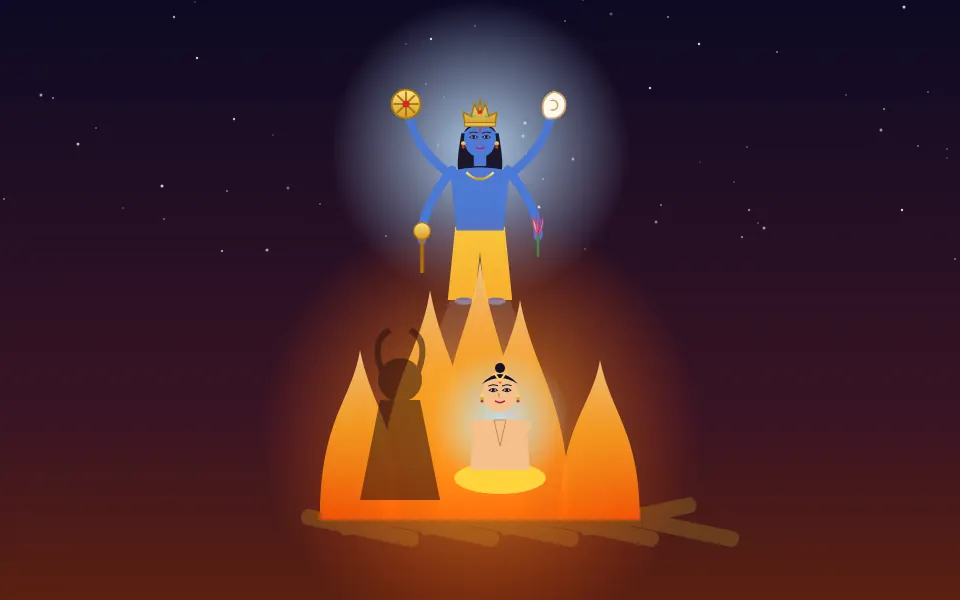
The best known story behind Holika Dahan comes from the Bhagavata Purana and other Puranas. Hiranyakashipu, a demon king, had won a boon that made him almost impossible to kill, and he ordered everyone to worship him in place of Lord Vishnu. His young son Prahlad refused. He kept praying to Vishnu even when he was thrown from a cliff and given poison. At last the king turned to his sister Holika, who had a boon that fire could not harm her. She sat in a blazing pyre with Prahlad on her lap. According to tradition, the boon failed because she used it for evil, Holika burned to ashes and Prahlad walked out unhurt, still praying. Soon after, Lord Vishnu appeared from a pillar as Narasimha, half man and half lion, and killed Hiranyakashipu at dusk on the threshold of the palace, a time and place his boon did not cover. The Holi bonfire recalls Prahlad's escape and the fall of a proud tyrant.

The colour play belongs to Radha and Krishna. Tradition says the young Krishna, dark in complexion, asked his mother Yashoda why Radha was so fair. She laughed and told him to colour Radha's face any shade he liked. Krishna and his cowherd friends went to Barsana, Radha's village, and smeared colour on Radha and the gopis, who chased them away with sticks. These games of Braj grew into the Holi people know today.
In parts of South India the full moon is linked instead to Kamadeva, the god of love, who was burnt by Shiva's third eye. A spring festival of this kind appears in old Sanskrit plays and poetry, and Mughal court paintings show emperors and nobles playing Holi, which shows how widely it was shared across communities.
How Holi is celebrated
Preparations start days before. A spot is chosen in the colony or village and wood, dry leaves and cow dung cakes are collected for the pyre. On the evening of Phalguna Purnima, women perform puja at the pyre with water, roli, rice, flowers, turmeric, coconut and raw cotton thread, which they wind around the pile while walking in circles. Ears of new wheat or barley are roasted in the fire, and many families carry home some embers or ash as a blessing.
The next morning is Dhulandi or Rangwali Holi. People play with dry gulal, coloured water and water guns. Groups move from house to house with dhol, singing Holi songs and dancing. By early afternoon the colour play stops, everyone bathes and puts on clean clothes, and the evening is spent visiting relatives and friends.
In many homes a small Holika is also made in the courtyard from cow dung cakes, and the family walks around it before the main bonfire. Children are given new clothes for the evening visits.
Symbols, food and customs of Holi
Fire and colour are the two signs of Holi. The bonfire stands for Holika and for the pride and cruelty that burn away, while the unhurt Prahlad stands for faith that survives. Many families keep a green stick in the pyre and pull it out as the fire rises, a sign of Prahlad being saved.
Colour belongs to Krishna, the dark god who coloured Radha's face. Red and pink gulal speak of love and joy, yellow of spring and turmeric, green of new crops and blue of Krishna himself. In earlier times colours came from flowers such as tesu (palash), from turmeric, henna and beetroot, and many people now use them again.
Food is a big part of the day. Gujiya stuffed with khoya and dry fruit, malpua, dahi bhalle, papri, namak pare and kanji vada fill North Indian kitchens, and thandai made with milk, almonds, fennel and pepper is served cold. Roasted ears of new wheat and barley from the bonfire are shared as prasad.
Play safe. Choose natural or herbal colours, oil your skin and hair first, and keep colour away from the eyes. If colour gets into an eye, wash it with plenty of clean water and see a doctor if pain or redness stays. Do not throw water balloons at people, animals or passing vehicles.
Holi across India
In Braj, Holi lasts more than a week and follows the story of Radha and Krishna closely. At Barsana, Radha's village, women of the village playfully beat the men of Nandgaon, Krishna's village, with long bamboo sticks during Lathmar Holi, while the men hide behind leather shields and sing teasing songs. The next day the roles return at Nandgaon. In Vrindavan, the Banke Bihari temple holds Phoolon wali Holi, when priests shower devotees with flower petals in place of colour. Dauji near Mathura holds the rough and joyful Huranga the day after Holi. In Bengal and Odisha the festival is Dol Jatra, when Radha Krishna idols are carried on swings, and Santiniketan celebrates Basanta Utsav. Sikhs gather at Anandpur Sahib for Hola Mohalla, Maharashtra plays colours again on Rangpanchami, Goa has Shigmo and Manipur celebrates Yaosang. In Varanasi, colour play begins at the Kashi Vishwanath temple on Rangbhari Ekadashi, a few days before Holi.
Kumaon in Uttarakhand has a distinct musical tradition. Baithki Holi, sung while seated and based on classical ragas, begins weeks earlier in winter. Khadi Holi is sung standing in village courtyards with dhol, and women hold their own Mahila Holi gatherings. A pole wrapped in cloth strips, called the cheer, is set up a few days before and burnt on Holika Dahan. In Dehradun, the Jhanda Mela at Darbar Sahib begins on the fifth day after Holi.
Offices, banks, markets and travel during Holi
Holi is a public holiday in most North Indian states. For 2027 the central government lists Holika Dahan on 22 March as a restricted holiday and Holi on 23 March as a holiday for central offices in Delhi.
Holi is a public holiday across North India, and offices, schools and most shops close on the colour day. For 2027 only the central government and court lists are out so far. Central government staff get Holi on Tuesday, 23 March 2027 as one of the three optional holidays chosen for central offices in Delhi, and Holika Dahan on Monday, 22 March 2027 is a restricted holiday (also listed for Dolyatra). The Supreme Court closes from 22 March 2027 for its Holi holidays, which run on to Good Friday, and the Uttarakhand High Court is closed on 22 March 2027. Good Friday on 26 March 2027 is a compulsory central holiday, so that week has a long break.
State government and bank holiday lists for 2027 usually come out in December 2026 or January 2027, so check them before planning. As a guide, in 2026 banks in Dehradun, Lucknow, Kanpur, New Delhi and Patna closed on Holi, 4 March. Lucknow and Kanpur banks also closed on Holika Dahan, 2 March, and banks in Patna, Dehradun, Lucknow and Kanpur closed on 3 March. Uttarakhand, Uttar Pradesh, Delhi and Bihar closed their state offices on Holi, and the stock exchanges were shut on 3 March 2026.
Trains to Bihar, eastern Uttar Pradesh and Braj fill up weeks ahead, so book early.
Other names and related festivals
- Dhulandi
- Dhulandi
- Dol Jatra
- Festival of Colours
- Phagwah
- Rangwali Holi
- Dhuleti in Gujarat
 Dol Jatra 22 Mar 2027
 Holika Dahan 22 Mar 2027
Frequently asked questions
When is Holi in 2027?
Holi falls on Tuesday, 23 March 2027.
Is Holi a bank holiday?
The RBI bank holiday lists for 2027 are not out yet; they usually come out in December or January. Each state follows its own list, so check your state's bank holiday page then.
Is Holi a central government holiday?
Holi is in the list of optional holidays. The central government employees' coordination committee of each state capital decides whether offices in that state close for it.
What are the other names of Holi?
Holi is also known as Dhulandi, Dol Jatra, Festival of Colours, Phagwah, Rangwali Holi, Dhuleti.
Why is Holi celebrated?
Holi marks the victory of devotion over arrogance through the story of Prahlad and Holika. It also welcomes spring and the ripening of the rabi crop.
What is the difference between Holika Dahan and Dhulandi?
Holika Dahan is the bonfire held on the full moon night. Dhulandi is the next day, when people play with colours and water.
What is Kumaoni Holi?
It is the Holi tradition of Kumaon in Uttarakhand, built around group singing. It includes Baithki Holi sung on classical ragas, Khadi Holi sung standing, and Mahila Holi.
How can I play Holi safely?
Use natural or herbal colours, apply oil on skin and hair before playing, and protect your eyes. Avoid throwing water balloons at people or animals.
What is Lathmar Holi?
Lathmar Holi is played in Barsana and Nandgaon in Braj. Women playfully strike the men with bamboo sticks while the men shield themselves, recalling how Radha and the gopis chased Krishna and his friends.
Next Hindu festivals (30 days)
-
17 OctSat
 Durga Puja
-
18 OctSun
 Durga Puja (Maha Saptami)
-
19 OctMon
 Durga Ashtami (Maha Ashtami)
-
20 OctTue
 Dussehra
-
20 OctTue
 Maha Navami
-
25 OctSun
 Sharad Purnima
-
26 OctMon
 Maharishi Valmiki Jayanti
-
29 OctThu
 Karva Chauth
-
6 NovFri
 Dhanteras
-
8 NovSun
 Diwali
-
8 NovSun
 Naraka Chaturdashi (Choti Diwali)
-
8 NovSun
 Lakshmi Puja
-
9 NovMon
 Govardhan Puja
-
11 NovWed
 Bhai Dooj
Major Hindu festivals
- 9 OctSatDussehra
- 29 OctFriDiwali
 Sharad Navratri
Upcoming central government holidays
Holidays in your state
Bank, state government and school holidays differ from state to state. Pick your state:
Holidays and festivals calendar: October and November 2026
Central government holidays for all of India and major festivals. For bank, state government and school holidays, open your state: Andhra Pradesh, Assam, Bihar, Chhattisgarh, Delhi, Goa, Gujarat, Haryana, Himachal Pradesh, Jammu and Kashmir, Jharkhand, Karnataka, Kerala, Madhya Pradesh, Maharashtra, Odisha, Punjab, Rajasthan, Tamil Nadu, Telangana, Uttar Pradesh, Uttarakhand, West Bengal.
| Mon | Tue | Wed | Thu | Fri | Sat | Sun |
|---|---|---|---|---|---|---|
| 1 | 2
Friday, 2 October Gandhi Jayanti Gandhi Jayanti on 2 October marks the birth anniversary of Mahatma Gandhi, the leader of India's freedom struggle and the voice of truth and non-violence. |
3 | 4 | |||
| 5 | 6 | 7 | 8 | 9 | 10 | 11
Sunday, 11 October Sharad Navratri Sharad Navratri is the nine night autumn festival of the Goddess Durga, beginning with Ghatasthapana and leading up to Dussehra, with fasting, prayer, garba... |
| 12 | 13 | 14 | 15 | 16 | 17
Saturday, 17 October Durga Puja Durga Puja celebrates Goddess Durga's victory over the demon Mahishasura with grand pandals, dhak drums, prayers and feasts, especially in West Bengal and ea... |
18 |
| 19 | 20
Tuesday, 20 October Dussehra Dussehra, or Vijayadashami, celebrates the victory of good over evil, recalling Lord Rama's defeat of Ravana and Goddess Durga's triumph over Mahishasura. |
21 | 22 | 23 | 24 | 25 |
| 26 | 27 | 28 | 29 | 30 | 31 |
| Mon | Tue | Wed | Thu | Fri | Sat | Sun |
|---|---|---|---|---|---|---|
| 1 | ||||||
| 2 | 3 | 4 | 5 | 6 | 7 | 8
Sunday, 8 November Diwali Diwali, the festival of lights, celebrates the victory of light over darkness with Lakshmi Puja, rows of diyas, sweets and family gatherings on the new moon... |
| 9 | 10 | 11 | 12 | 13 | 14 | 15
Sunday, 15 November Chhath Puja Chhath Puja is a four day festival of Bihar and eastern India in which devotees fast and offer arghya to the setting and rising Sun while standing in water. |
| 16 | 17 | 18 | 19 | 20 | 21 | 22 |
| 23 | 24
Tuesday, 24 November Guru Nanak Jayanti Guru Nanak Jayanti, or Prakash Purab, celebrates the birth of Guru Nanak Dev Ji, the founder of Sikhism, with prayers, nagar kirtans, langar and lit up gurdw... |
25 | 26 | 27 | 28 | 29 |
| 30 |
Public holiday Major festival Today
- Sat, 17 Oct
Durga Puja
- Tue, 20 Oct
Dussehra
- Sun, 8 Nov
Diwali
- Sun, 15 Nov
 Chhath Puja
 - Tue, 24 Nov
 Guru Nanak Jayanti