National
 Independence Day 2027 स्वतंत्रता दिवस
India's Freedom Day
Sunday, 15 August 2027
Independence Day marks the end of British rule on 15 August 1947, and in 2026 India celebrates its 80th Independence Day with flag hoisting across the country.
How the date is fixed: Fixed date: 15 August every year
Why Independence Day is celebrated
On 15 August 1947 India became a free nation after nearly two hundred years of British control. Independence Day honours that moment and the millions of people who struggled for it, from soldiers of 1857 to farmers, students, writers, women and leaders who went to jail or gave their lives. It reminds citizens that freedom was earned at a great cost.
The day is also about what India chose to become after freedom: a democracy where every adult can vote, a republic bound by a Constitution, and a country that holds many languages, faiths and cultures together. The tricolour flag, with saffron for courage and sacrifice, white for truth and peace, green for faith and growth, and the navy blue Ashoka Chakra for the wheel of law, sums up these ideals.
For most families it is a day of pride, but it also carries a sad memory. Freedom came with the Partition of the country, and the government marks 14 August as Partition Horrors Remembrance Day to remember those who suffered.
History and story of Independence Day
Organised resistance to British rule grew through the nineteenth century, with the revolt of 1857 as an early turning point. The Indian National Congress, formed in 1885, began by asking for reforms but later demanded full freedom. At its Lahore session in December 1929 it adopted the goal of Purna Swaraj, and 26 January 1930 was observed as Independence Day by the national movement. That date later became Republic Day.
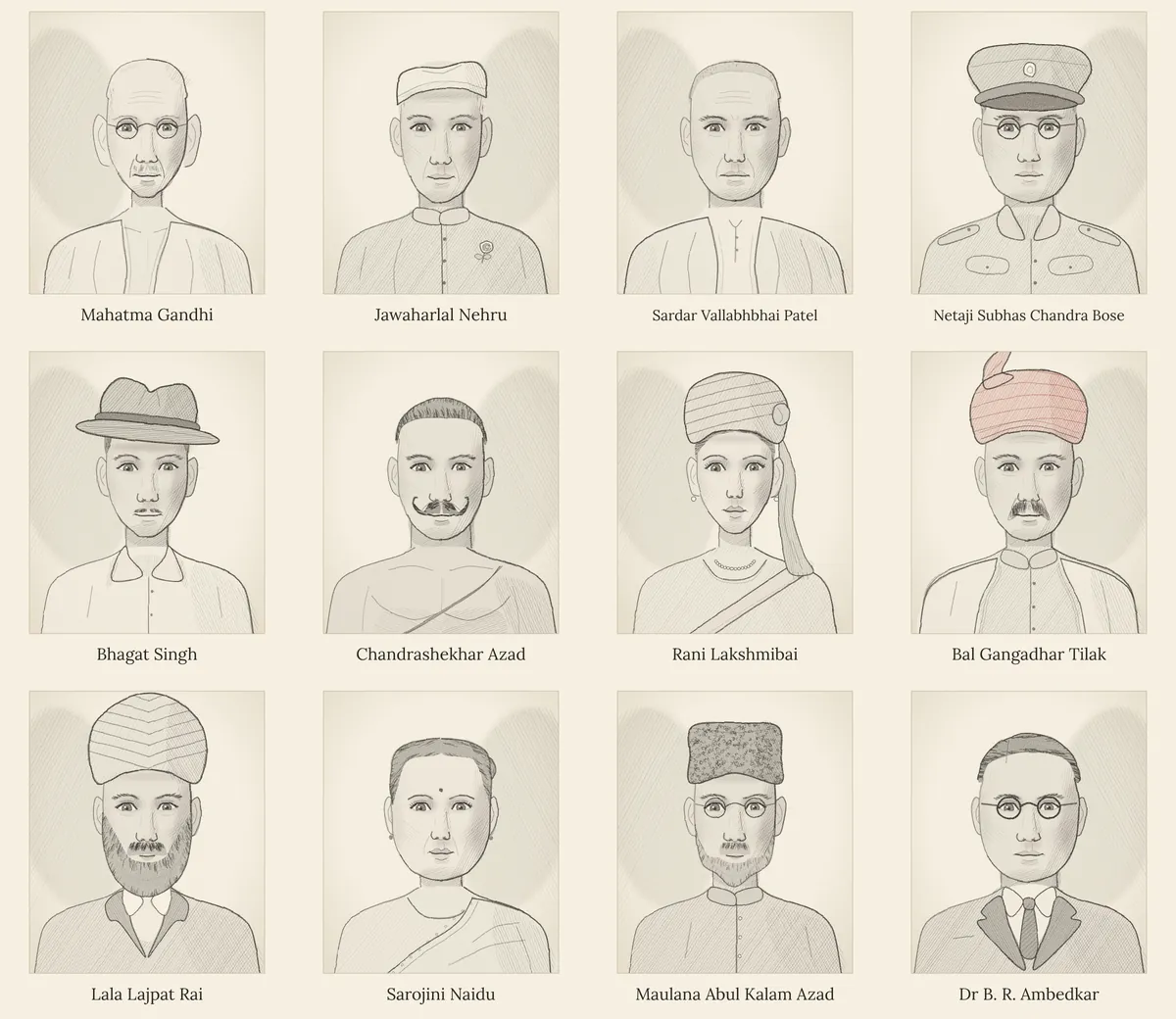
Under Mahatma Gandhi the struggle drew in ordinary people through non-cooperation, the Salt March and the Quit India Movement of 1942. Revolutionaries such as Bhagat Singh and Chandrashekhar Azad, and Subhas Chandra Bose with the Indian National Army, added their own pressure. After the Second World War Britain was weakened and could no longer hold India.
In early 1947 the British government said it would leave by June 1948. Lord Mountbatten, the last Viceroy, brought the date forward, and under the 3 June Plan the country was divided into India and Pakistan. The British Parliament passed the Indian Independence Act in July 1947. Mountbatten chose 15 August because it was the second anniversary of Japan's surrender in the Second World War.
At midnight on 14 and 15 August, Jawaharlal Nehru spoke to the Constituent Assembly in his famous Tryst with Destiny speech. Partition led to one of the largest migrations in human history and terrible violence on both sides of the new border.
How Independence Day is celebrated

The main national event takes place at the Red Fort in Delhi. The Prime Minister hoists the national flag from its ramparts, a 21-gun salute is fired, and the national anthem is played. The Prime Minister then addresses the nation, reviewing the past year and announcing plans. On the evening before, the President speaks to the country on radio and television, and gallantry awards are announced.
Across India, flags go up at government offices, schools, colleges, housing societies and village panchayats. Schools hold march pasts, patriotic songs, speeches and plays about freedom fighters, and sweets are given out. Since 2022 the Har Ghar Tiranga campaign has encouraged families to fly the flag at home. Under the amended Flag Code, citizens may display the tricolour day and night, but it must be treated with respect and never used as a costume or thrown away carelessly.
Kite flying is a popular custom in Delhi and parts of Uttar Pradesh, with skies full of tricolour kites. Many people also visit war memorials and watch patriotic films.
Important days and moments
- President's address (Evening of Friday, 14 August 2026)
The President speaks to the nation on the eve of Independence Day, broadcast on radio and television. - Flag hoisting at Red Fort (Morning of Saturday, 15 August 2026)
The Prime Minister hoists the tricolour, a 21-gun salute is fired, and the national anthem is played. - Prime Minister's speech (15 August 2026, after flag hoisting)
The Prime Minister addresses the nation from the ramparts of the Red Fort. - State and school ceremonies (15 August 2026, morning)
Chief Ministers hoist the flag in state capitals, and schools hold parades, songs and cultural programmes.
Independence Day across India
Every state capital holds its own ceremony, where the Chief Minister hoists the flag and police and school contingents take part in a parade. In Dehradun, the Uttarakhand Chief Minister leads the state function, and towns across the hills hold flag hoisting in schools and market squares.
Uttarakhand has its own place in the freedom story. In 1921 the people of Kumaon ended the forced labour system called coolie begar at the Uttarayani fair in Bageshwar. In 1930 Chandra Singh Garhwali and soldiers of the Garhwal Rifles refused to fire on unarmed protesters in Peshawar. Sridev Suman died in Tehri jail in 1944 after a long fast against the princely state's rule, and Tehri joined India in 1949.
The day is also the birth anniversary of Sri Aurobindo, so Puducherry holds special events. At the Attari Wagah border near Amritsar, the evening ceremony draws very large crowds on 15 August.
Other names and related festivals
- 15 August
- Azadi Diwas
- Swatantrata Diwas
Frequently asked questions
When is Independence Day in 2027?
Independence Day falls on Sunday, 15 August 2027.
Is Independence Day a bank holiday?
The RBI bank holiday lists for 2027 are not out yet; they usually come out in December or January. Each state follows its own list, so check your state's bank holiday page then.
Is Independence Day a central government holiday?
Yes. Independence Day is one of the compulsory holidays for all central government offices in 2027.
What are the other names of Independence Day?
Independence Day is also known as 15 August, Azadi Diwas, Swatantrata Diwas.
Which Independence Day is celebrated in 2026?
India celebrates its 80th Independence Day on 15 August 2026, marking 79 years since 1947.
Why was 15 August chosen?
Lord Mountbatten picked the date because it was the second anniversary of Japan's surrender in the Second World War in 1945.
What is the difference between flag hoisting and flag unfurling?
On Independence Day the flag is pulled up from the bottom of the pole, called hoisting, to recall the raising of a new flag. On Republic Day the flag is already at the top and is unfurled.
Who hoists the flag at the Red Fort?
The Prime Minister hoists the flag at the Red Fort and then addresses the nation.
Can I fly the national flag at home at night?
Yes. After the 2022 changes to the Flag Code, citizens may fly the tricolour day and night, as long as it is treated with respect.
Next National festivals (30 days)
No other festival in the next 30 days.
Major National festivals
- 26 JanTue
 Republic Day
 - 2 OctSat
 Gandhi Jayanti
Upcoming central government holidays
Holidays in your state
Bank, state government and school holidays differ from state to state. Pick your state:
Holidays and festivals calendar: October and November 2026
Central government holidays for all of India and major festivals. For bank, state government and school holidays, open your state: Andhra Pradesh, Assam, Bihar, Chhattisgarh, Delhi, Goa, Gujarat, Haryana, Himachal Pradesh, Jammu and Kashmir, Jharkhand, Karnataka, Kerala, Madhya Pradesh, Maharashtra, Odisha, Punjab, Rajasthan, Tamil Nadu, Telangana, Uttar Pradesh, Uttarakhand, West Bengal.
| Mon | Tue | Wed | Thu | Fri | Sat | Sun |
|---|---|---|---|---|---|---|
| 1 | 2
Friday, 2 October Gandhi Jayanti Gandhi Jayanti on 2 October marks the birth anniversary of Mahatma Gandhi, the leader of India's freedom struggle and the voice of truth and non-violence. |
3 | 4 | |||
| 5 | 6 | 7 | 8 | 9 | 10 | 11
Sunday, 11 October Sharad Navratri Sharad Navratri is the nine night autumn festival of the Goddess Durga, beginning with Ghatasthapana and leading up to Dussehra, with fasting, prayer, garba... |
| 12 | 13 | 14 | 15 | 16 | 17
Saturday, 17 October Durga Puja Durga Puja celebrates Goddess Durga's victory over the demon Mahishasura with grand pandals, dhak drums, prayers and feasts, especially in West Bengal and ea... |
18 |
| 19 | 20
Tuesday, 20 October Dussehra Dussehra, or Vijayadashami, celebrates the victory of good over evil, recalling Lord Rama's defeat of Ravana and Goddess Durga's triumph over Mahishasura. |
21 | 22 | 23 | 24 | 25 |
| 26 | 27 | 28 | 29 | 30 | 31 |
| Mon | Tue | Wed | Thu | Fri | Sat | Sun |
|---|---|---|---|---|---|---|
| 1 | ||||||
| 2 | 3 | 4 | 5 | 6 | 7 | 8
Sunday, 8 November Diwali Diwali, the festival of lights, celebrates the victory of light over darkness with Lakshmi Puja, rows of diyas, sweets and family gatherings on the new moon... |
| 9 | 10 | 11 | 12 | 13 | 14 | 15
Sunday, 15 November Chhath Puja Chhath Puja is a four day festival of Bihar and eastern India in which devotees fast and offer arghya to the setting and rising Sun while standing in water. |
| 16 | 17 | 18 | 19 | 20 | 21 | 22 |
| 23 | 24
Tuesday, 24 November Guru Nanak Jayanti Guru Nanak Jayanti, or Prakash Purab, celebrates the birth of Guru Nanak Dev Ji, the founder of Sikhism, with prayers, nagar kirtans, langar and lit up gurdw... |
25 | 26 | 27 | 28 | 29 |
| 30 |
Public holiday Major festival Today
- Sat, 17 Oct
 Durga Puja
 - Tue, 20 Oct
 Dussehra
 - Sun, 8 Nov
 Diwali
 - Sun, 15 Nov
 Chhath Puja
 - Tue, 24 Nov
 Guru Nanak Jayanti